From estimate to wrap, one system runs the whole production.
A purpose-built ERP for film, television, and commercial production — replacing the spreadsheet-and-inbox sprawl that runs most shoots with a single source of truth, from the first budget line to the signed closure document.
Every project ran on different tools, and the real number arrived too late.
A production house runs many projects at once with a crew that is mostly freelance. Budgets start their life in spreadsheets. Contracts live in email threads. Purchase orders get approved over text and reconciled from memory. Casting and location scouting happen in someone's head or a folder of reference photos.
The result is predictable: nobody knows a project's true position until it is over — by which point overruns are already sunk cost. When a shoot wraps, building the closure document means chasing every department for figures that no longer reconcile.
The ERP mirrors the lifecycle of a production itself.
Each stage hands off to the next inside one system, so the budget set on day one is the same record being reconciled at closure — no re-keying, no parallel versions, no drift.
Build the estimate on the AICP bid form
A producer builds a line-item estimate before the project is greenlit — on the AICP Bid Form, the format every agency expects and uses to compare competing bids side by side. Sections, fees, and fringes are structured in from the start, so the estimate is agency-ready, not a blank spreadsheet.
Convert the estimate into a live project
One action turns an approved estimate into an active project, carrying every budget line across as the committed baseline to track against. Nothing is re-entered and nothing is lost in translation.
Add the team, freelancers, and contracts
Staff and freelancers are added to a shared production roster, and contracts are generated against each engagement — terms, dates, and rates captured against the person and the project, not buried in an inbox.
Raise purchase orders
POs are issued to freelancers and vendors and tied to specific budget lines, so every commitment is visible before money goes out — not discovered after.
Track budget vs. actual
A live view of estimated, committed, and actual spend per line and per project. Overruns surface while there is still room to act, turning the budget from a post-mortem document into a steering instrument.
Generate the project closure document
On completion the system assembles the full closure document automatically — final budget reconciliation, contracts, purchase orders, and the complete project record compiled into a single deliverable, the moment the shoot wraps.
What a production manager sees, live.
The dashboard surfaces every critical number in one view — active projects, budget utilisation, schedule progress, freelancer check-ins, and upcoming milestones — so a production manager can make decisions without opening a single spreadsheet.
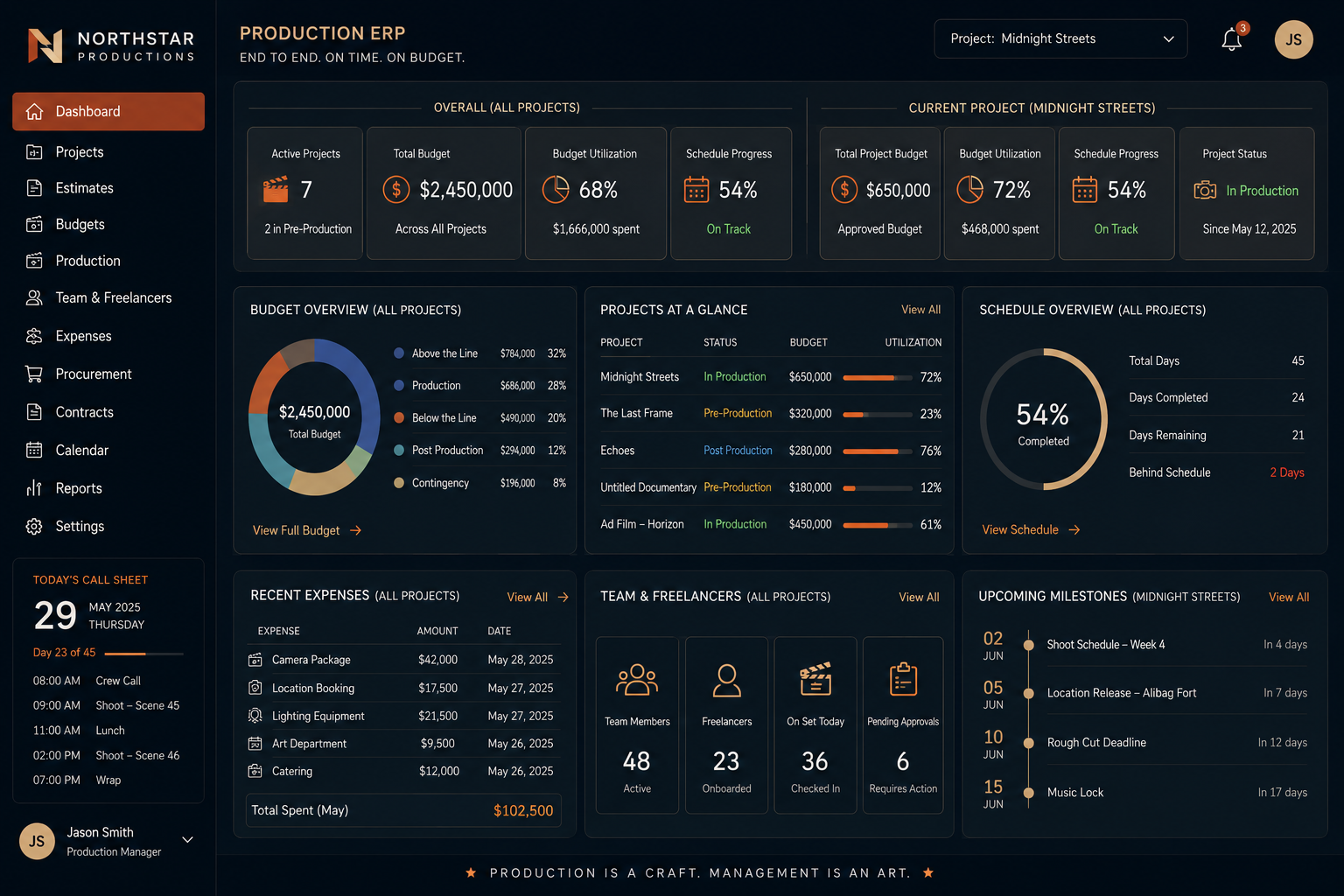
// Indicative dashboard — representative of the live production environment.
The estimate phase is a full AICP bidding engine.
Because the estimate is built on the AICP Bid Form — the standard US agencies require and use to compare bids in a triple-bid review — the work a producer does to win a job is the same record that runs the project and reconciles at wrap. These are the capabilities layered on top of that format.
AICP sections, pre-loaded
The full lettered structure ships built in — from prep and shoot crew through equipment, talent, and post finishing — so nothing is missed and every bid lands in the exact shape an agency auditor expects.
Fees, fringes & contingency, live
Production fee, insurance, and contingency apply as percentages on top of below-the-line costs, with per-section overrides (a reduced fee on travel or P&W) and union fringes on labor lines — calculated instantly, with no broken cell references.
One form, estimate to actual
Every AICP line carries estimated and actual side by side. Actuals flow back from the purchase-order log and timesheets, so the bid you submitted becomes the cost report you reconcile at wrap — one artifact, no re-keying.
Pricing pulled from the database
Crew day rates, equipment packages, and talent and location costs draw from the shared libraries, so estimates are fast to assemble and pricing stays consistent from one job to the next.
Scenarios without file sprawl
Bid revisions and alternate scopes — a 15s/30s/60s set, an added shoot day, a weather-day contingency — live as versions of one budget instead of a folder of conflicting spreadsheets.
The bid package, generated
Top sheet, detailed cost breakdown, bid letter, and production calendar generate from the same data into a client-ready document — with per-section currency conversion for cross-border shoots.
Three libraries the whole studio draws from.
Client & creative relationships
A lightweight CRM that records the preferences — the likes and dislikes — of clients, agencies, and directors, so the next pitch and the next shoot start from what already worked with that relationship.
Location library
Every available shoot location in one searchable catalogue. Each location is tagged by its features, so a producer can filter to an exact brief in seconds instead of scrolling through a folder of photos.
Talent management
A database of talent that casting draws from directly. Profiles are tagged across attributes — including features and ethnicity — so a casting brief becomes a filter, not a manual search.
Control within a project — and across the whole slate.
Estimates, contracts, POs, and actuals all bind to the same budget lines, so variance is computed live — and the same records generate the closure document at wrap.
Capital decisions from the data
Rental spend per equipment item accrues across projects; when it crosses the cost of owning, the buy-vs-rent crossover surfaces on its own.
Negotiate from real numbers
Spend per vendor rolls up across the slate, so the suppliers earning the most business surface on their own — leverage for the next rate negotiation.
One source of truth, from first estimate to final wrap.
// Measured across live productions after rollout.
Built around how productions actually work.
Rather than bending a generic ERP to fit film, the system was designed along the production lifecycle a studio already lives by — estimate, greenlight, crew, commit, control, wrap — with the CRM, location, and talent libraries feeding every project underneath. The closure document, once a week of chasing, became the natural end of a process that was tracking itself the whole time.